

Are Your AI Agents Reliable?
Exploring how frameworks like τ²-bench and Pydantic Evals are shaping the science of evaluating AI agent reliability in production.

Introduction
As I wrap up my first week at moyai, I’ve encountered many new concepts - but none has fascinated me more than the τ²-bench framework for evaluating conversational AI agents [1].
τ²-bench combines rigorous evaluation methodology with practical metrics for measuring agent performance. But how do you evaluate systems that are fundamentally non-deterministic, where the same input might produce different outputs each time? This is the central challenge that τ²-bench addresses.
In this article, I’ll break down what τ²-bench is, why it represents a step forward in agent evaluation, and how it connects to broader evaluation frameworks like Pydantic Evals from the Pydantic AI project [2].
The Challenge
Modern AI agents are not just a system prompt and a user prompt with a few RAG services on top. They are sophisticated systems that can maintain context across conversations, call external tools, read and write to databases, and complete complex multi-step tasks reliably. As LLMs evolve rapidly, so do the agents built on top of them.
This creates a real evaluation problem. Traditional LLM benchmarks test a model’s ability to produce a correct answer to a question. But agents don’t just answer questions - they take actions. How do you measure whether an agent did the right thing across a multi-turn conversation where both sides are actively participating?
This is exactly the gap that τ²-bench was designed to fill [3].
How τ²-bench works
τ²-bench is a dual-control simulation framework developed by Sierra Research [4]. Unlike traditional benchmarks where the user passively provides information, τ²-bench simulates realistic scenarios where both the AI agent and a simulated user can actively use tools to modify a shared environment. Or have some fun with it, if you want to role play as a user and/or agent :)
Think of a customer calling tech support because their internet is down. The support agent needs to run backend diagnostics, but the customer also needs to restart their router, check cables, or change settings on their device. Both sides must take actions and coordinate effectively to resolve the issue. This dual-control dynamic is what τ²-bench evaluates.
Each task in τ²-bench involves three key components:
- AI agent with access to API tools (e.g., querying account status, modifying plans)
- User simulator (also AI-powered) that behaves like a real customer with its own set of actions
- Shared database tracking the state of the environment (implemented as local JSON files)
The benchmark spans multiple domains: (1) Telecom, (2) Airline, and (3) Retail. Each domain is with its own set of tools, policies, and realistic customer scenarios. After each task, τ²-bench verifies not just whether the agent gave a correct final answer, but whether the resulting database state is correct.
A Little Example
Here’s what a τ²-bench task might look like in the Telecom domain:
Scenario: A passenger needs to change their flight due to a missed connection and requires rebooking with baggage transfer.
Dual-control challenge:
- The agent can search alternative flights, modify the booking in the airline system, and update baggage routing
- The passenger (user simulator) needs to confirm their destination preferences, provide payment authorization for fare differences, and verify their new boarding pass
- Both actions are required to complete the rebooking
- The agent must coordinate with the passenger on options while executing backend changes
What gets evaluated:
- Did the agent identify viable alternative flights that meet the passenger’s constraints?
- Did it clearly communicate options and wait for passenger confirmation before rebooking?
- Did both the agent and passenger execute the right sequence of tool calls (search → confirm → pay → update baggage)?
- Was the final database state correct (new booking confirmed, old booking cancelled, baggage rerouted, payment processed)?
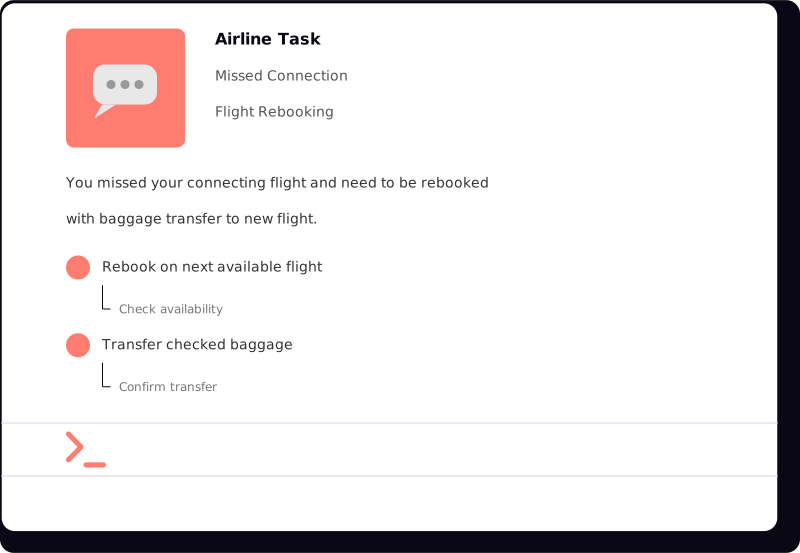
This multi-actor coordination is what makes τ²-bench challenging and realistic. You can explore it interactively and see how different models perform on the τ²-bench leaderboard [5].
Why τ²-bench Is Getting Traction
τ²-bench is gaining adoption across major AI labs: Anthropic, OpenAI and Google have all used it for model evaluation. The reason is straightforward. It tests agent reality and not just model intelligence.
Most benchmarks measure whether an LLM can produce a correct answer. τ²-bench measures whether and agents can actually do the job. Can it follow procedures, policies, taking the right tools in the correct order, manage state across multiple turn conversations and coordinate with a user who is also taking actions. This matters in production.
Simply put:
- Traditional benchmarks test if a model knows the right answer
- τ²-bench tests if an agent can execute the right workflow - calling correct APIs, modifying databases, and maintaining conversation context across many turns
Getting any one of these wrong means failure - even if the agent’s conversational output says correct [3].
The novelty of this τ²-bench approach is also in its coordination and dual-control possibility to play as an agent or user or play it autonomously. It’s not just LLM acting on the environment, it’s also a real customer who is making the environment happen.
Shaping the Science to Evaluate LLM Agents
τ²-bench
Studying τ²-bench has been a rewarding experience. The bench goes beyond simple LLM evaluation and it provides a clear and elegant methodology for testing complex agentic AI systems. In a space where you have to apply quantitative measures to highly stochastic actions, this feels like a huge stepping stone towards new best practices in AI engineering and a potential new standard.
Success/failure metric
Many agents rely on “LLM-as-judge” scoring, asking another LLM to rate whether the response was good. This introduces LLM subjectivity, biases and non-reproducibility. τ²-bench puts this on the side and relies solely on database state verification. This means that each tasks has only one correct outcome. It is asking questions like:
- Did the customer’s plan get changed?
- Was the refund processed?
- Did it respond with the correct calculation?
reliability metrics
τ²-bench also introduces a metric that exposes a problem most benchmarks hide: consistency. They introduce as a consistency metric which asks: if an agent attempts the same task times, does it succeed on every single attempt?
- - the agent’s success rate on a single try
- - the percentage of tasks where the agent succeeds all 8 times in a row
A model in τ²-bench scored 61% on but only 25% on . In other words, while it handles 6 out of 10 tasks on the first attempt, it can only handle the same task reliably every time for 1 in 4 tasks. The rest are a coin flip - sometimes it works, sometimes it doesn’t. That’s exactly the kind of inconsistency you need to catch before deploying to production [6].
Pydantic Evals
But evaluation doesn’t stop just at benchmarks. Developers also need code-level testing frameworks to validate agent behavior in their own applications. This is where tools like Pydantic Evals come in. Because you do have to have certain evaluation techniques to write “unit-tests” for LLMs and agentic software implementation.
But even according to their own disclaimer we should be careful not to get too ahead of ourselves.
Unlike unit tests, evals are an emerging art/science. Anyone who claims to know exactly how your evals should be defined can safely be ignored. We’ve designed Pydantic Evals to be flexible and useful without being too opinionated.
Code-Level Evaluations aka Pydantic Evals
Pydantic Evals is a code-first evaluation framework from the Pydantic AI project. Think of it as a unit testing framework, but for AI applications - you define test cases with inputs, expected outputs, and metadata, then run them against your agent, to verify that it behaves as intended.
case1 = Case(
  name='simple_case',
  inputs='What is the capital of France?',
  expected_output='Paris',
  metadata={'difficulty': 'easy'},
)
What makes Pydantic Evals particularly powerful for agent evaluation is segment-based evaluation - the ability to inspect internal agent behavior (tool calls, decision paths) using OpenTelemetry traces, not just final outputs. This means you can verify not only what your agent answered, but how it got there [2].
While τ²-bench gives you a standardized benchmark to compare against, Pydantic Evals give you the tools to build continuous evaluation into your own development workflow.
Why This Matters
Running evaluations with frameworks like τ²-bench won’t answer every production question which agentic developers might have, but they can provide a standardized baseline for measuring reliability and identifying where to look for improvements.
AI agents are often treated as black boxes. Simply put, we provide the input, and the agent gives us an output. The steps in between (which tools it called, what information it retrieved, how it retrieved, how it decided what to do next), are invisible by default. Evaluation frameworks and telemetry tools change this. They give us visibility into the internal decision-making process, turning a black box into a slightly permeable box. With this information we can reason, measure and further improve.
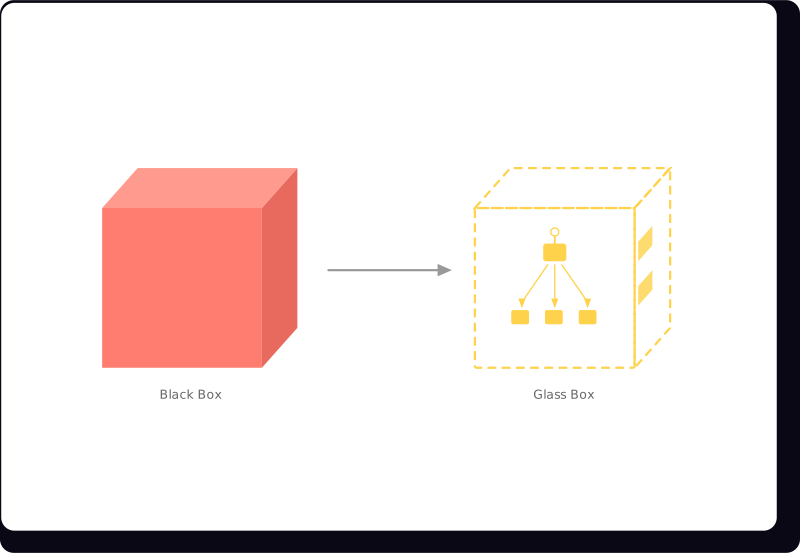
The shift towards measurable evaluation is essential. As AI agents become more capable and are deployed in complex tasks with high-stakes scenarios, having robust evaluation practices isn’t just nice to have - it becomes a requirement.
Reflections
The first week experiencing moyai showed me how much thought goes into evaluating AI agents properly. At the same time, because it’s a novel field, it is a great experience to be at the forefront, and that you are flirting with uncertainty more often than most software/AI engineers. That goes without saying that human experience is a little bit like this, you are constantly trying to make sense of things, so this approach nicely mirrors reality.
From a technical perspective, the τ²-bench and tools like Pydantic Evals represent a shift towards treating agent evaluation with the same ordeal we apply to traditional software testing. Monitoring software was always important, but it is done in such a way that there are always deterministic, predefined rules and we are only checking the symptoms.
When there are symptoms, we can diagnose the problem, but in the field of agent reliability we are making the solution on how to prevent these symptoms from happening again. We are fixing the problem forward. And every prevention is surely always better than a cure.
References
[1] Sierra Research, “τ²-bench,” GitHub repository. [Online]. Available: https://github.com/sierra-research/tau2-bench
[2] Pydantic, “Pydantic Evals Documentation,” ai.pydantic.dev. [Online]. Available: https://ai.pydantic.dev/evals/
[3] Sierra Research, “τ²-bench: Evaluating Agents in Multi-Turn Collaborative Tasks,” arXiv:2506.07982, 2025. [Online]. Available: https://arxiv.org/abs/2506.07982
[4] Sierra Research, “τ²-bench Overview,” sierra.ai. [Online]. Available: https://sierra.ai/resources/research/tau-squared-bench
[5] Sierra Research, “τ²-bench Leaderboard,” taubench.com. [Online]. Available: https://taubench.com
[6] Sierra Research, “Benchmarking AI Agents,” sierra.ai blog. [Online]. Available: https://sierra.ai/blog/benchmarking-ai-agents
Wrap-up
AI agents can look fine in demos and still fail in production. Moyai helps teams catch reliability issues early with clustering, evaluation, and actionable alerts.
If that sounds like the kind of tooling you want to use — try Moyai or join us on Discord .